
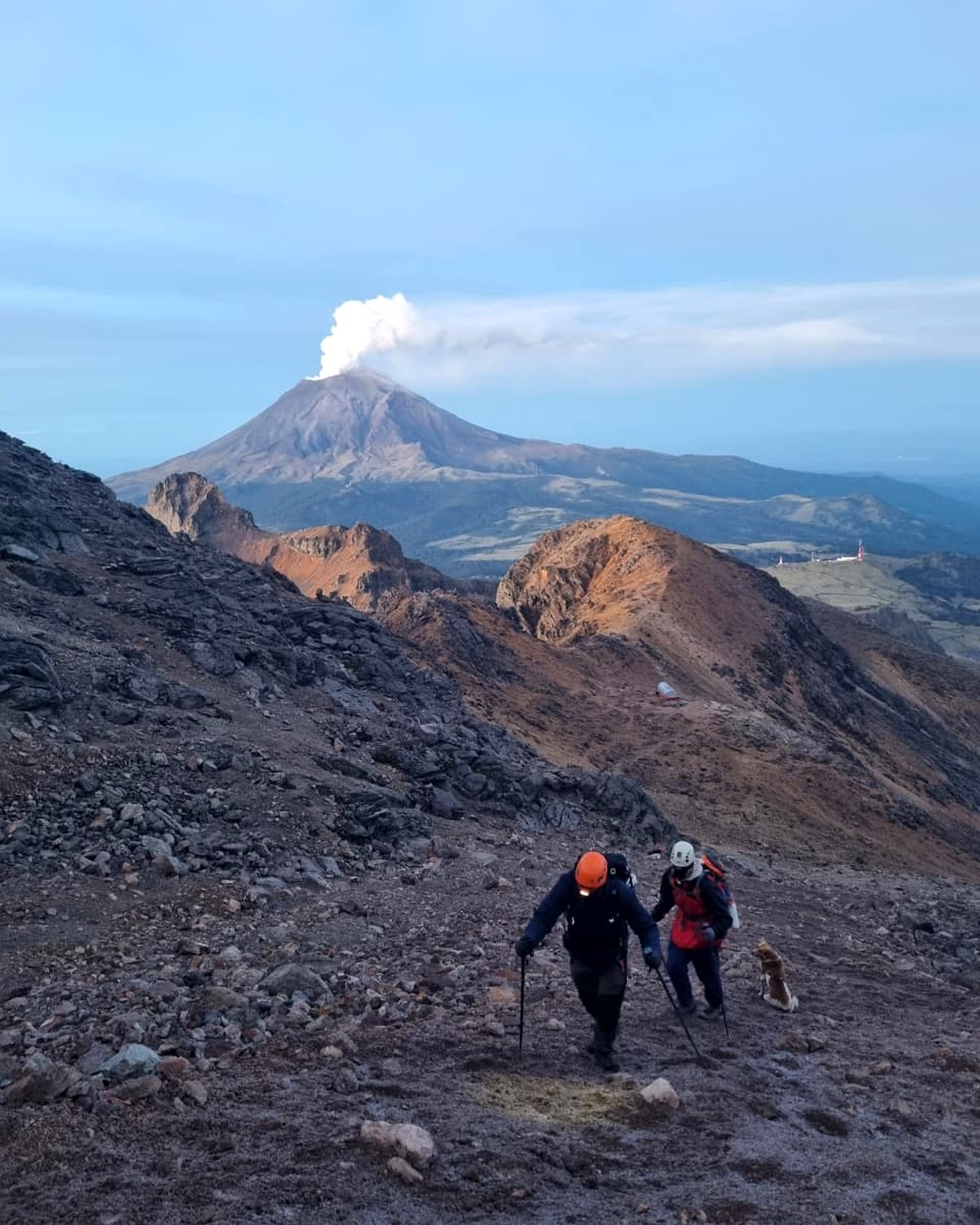
Zone 2 Training for Mountaineering: What My Own Heart Rate Data Taught Me
At the end of August I went through three months of my own Garmin data and read it the way I read a client's health form before a climb. Every run in there averaged between 138 and 156 beats per minute. Not one of them was easy.
I'm a mountain guide, so I'm supposed to know this. It's still easy to miss in your own training, and if you run a few times a week and all of it feels medium, it's probably happening to you too. This post is what I changed, what the numbers did over the next four weeks, and what I'd take from it if you're training for Pico de Orizaba or Iztaccíhuatl.
The short version. Zone 2 is the effort you could hold a conversation at for hours. For me, for now, that's under 135 beats per minute. If every run feels medium, you're probably living in zone 3, which tires you more than easy running and does less for you than a real hard session. For the mountain, do your zone 2 walking uphill with a pack, eat while you do it, and keep one strength day, because the engine isn't the only thing a summit day tests.
01 · What the watch said
Every easy run was a medium run
Zone 2 is the effort just under your aerobic threshold. You can talk in full sentences, you could breathe through your nose if you had to, and you can keep going for hours. It's where most of an endurance base gets built, and it's why well-trained endurance athletes do roughly 80 percent of their training at easy intensity [1].
Zone 3 sits just above it, and it feels like training, which is the problem. It's hard enough that you can't do much of it without getting tired, and not hard enough to give you what a real hard session does. That middle is where all of my running lived.
The watch said something about the mountain, too. It estimated my VO2max at 51, which is a good engine for a 35-year-old. But the longest session in those 90 days was 1.8 hours, and the most I'd climbed in one go was 293 m. Summit day on Pico de Orizaba is about 1,375 m of ascent from the hut at 4,260 m, 6 to 9 hours up and 3 to 4 down. I had the engine and none of the hours.
The year before was worse. In 2025 I was running 95 to 120 km a week without a base under it, and in October I dropped out of a 100 km race in Urique, in the Copper Canyon, at kilometer 63. For a long time I believed my heart had given out. When I finally went through the data, it pointed away from my heart. My heart rate sat in zone 1 for hours while every step felt like a maximal effort. My ground contact time nearly tripled and my running power fell from 315 to 53 watts. The engine wasn't what ran out. Everything pointed at my legs, and in the 22 months before that race I had done two strength sessions.
02 · The ceiling
A ceiling of 135
So every easy session now has a ceiling of 135 beats per minute. It's a provisional number, not a tested threshold. The session is written in time, not distance, 50 minutes under 135. When my heart rate goes over, I walk until it comes back down, and the walking counts as part of the run.
The first run under it, on September 8, was 6.5 km in 53 minutes at 8:08 per kilometer, with an average of 126. It was the lowest average heart rate of any run in three months, and a lot slower than what I used to call easy.
Fifteen days later I ran a similar route, this time with a chest strap. The first run was on the wrist, so read the heart rate row loosely.
| September 8 | September 23 | |
|---|---|---|
| Distance | 6.5 km | 6.47 km |
| Time | 53 min | 50 min |
| Pace | 8:08 per km | 7:44 per km |
| Average heart rate | 126 (wrist) | 123 (chest strap) |
| Climbing | 82 m | 88 m |
That's 24 seconds per kilometer faster at three beats lower. One comparison isn't a trend. It's the direction you want, though, the same effort a little faster, and it's the number I'll keep watching.
One practical note. On September 22 I did my hill session without the strap. The wrist reading was all over the place, so that session's heart rate doesn't count for anything. If you want to compare one week with the next, wear a chest strap.
03 · The group run
The gray zone is social
My running group in Mexico City does hills on Tuesday and an easy run on Friday. When I talked it through in September, I put it like this, "it's always zone three for me, always. That's not training."
Nobody in the group is doing anything wrong. A group runs at the group's pace, and if that pace is faster than your easy, you're in the gray zone every time you show up.
I'm not leaving the group, so the group gets a job. Starting in October, the Tuesday hills with them are my one fast session of the week, with no heart rate cap. The Friday run only counts if I stay at the back under 135 and walk the climbs; if I can't, I skip it and see them on Tuesday. Two hard days a week at most, the hills and the long mountain day, never three. The long day is hard because of its length, not its pace.
I got a preview on September 26, a Saturday run with friends in Chihuahua. 84 minutes, average 119, max 139, and only 1 minute 46 seconds in zone 3. They went up into zone 3, and I stayed under the line.
04 · On the hill
Walk uphill with the pack you'll carry
Running builds the engine. A mountain asks for something narrower, hours of walking uphill with weight on your back and then the walk down. So the most important session of my week isn't a run. It's Sunday on Cerro Grande, in Chihuahua, walking up and down with a pack under the same ceiling.
On September 6 that was 467 m of climbing with 7.2 kg on my back, at an average heart rate of 113. A week later I took the longer route with 10 kg, 458 m at an average of 117. Almost three more kilos for four beats.
Steep ground pushes the number up, and that's fine. On September 20, on a different hill with 5 kg, my average was 113 and my peak was 146. The rule on the hill is simple. When your heart rate crosses the ceiling, shorten your step until it comes back. A spike on the steepest pitch is normal. Spending the whole climb above the line isn't.
The number I've started tracking on these days isn't pace. It's meters climbed per hour while staying under 135, with the same pack, on the same hill, because that's the number a summit day spends. Orizaba's summit day is six to nine hours of uphill. Acclimatization is half of getting through it, and the other half is a lot of uphill hours that felt easy at home.
05 · The part I skipped
The long day is where you practice eating
The Sunday data showed one more thing, and it has nothing to do with heart rate. On September 20 I ate a banana and an apple at the top and nothing on the way up. I don't really eat on the mountain, and I need to train it.
That doesn't work on a summit day, and zone 2 is where you fix it. At an easy effort you can eat while you move, and your gut adapts. Eat during training often enough and you absorb more with less trouble [2]. The standard guidance is 30 to 60 g of carbohydrate per hour for efforts of one to two and a half hours, and up to 90 g for longer ones [3].
Starting with the long day on September 27, I set a watch alarm every 30 minutes from minute 30 and take one bite every time it goes off. Half a banana, half a bar or four small dates, about 15 to 20 g each. By the long days in October I want 60 g an hour. Our summit fueling plan has more on eating on Orizaba.
06 · Before your climb
How to use this for Orizaba or Izta
- Find your number. Talking in full sentences is a start. A heart rate drift test is better. Warm up for 15 minutes, then settle into the pace that puts your heart rate at the number you want to test, and hold that pace for an hour on flat ground or a treadmill. If your average heart rate in the second half is less than 5 percent higher than in the first, that starting number is under your aerobic threshold [4]. Under 3.5 percent, test again 5 beats higher. Wear a chest strap.
- Keep most of the week easy. Two hard days at most, one hill or interval session and the long day. Everything else under your ceiling.
- Make the long day specific. Uphill, with the pack you'll carry, under the same ceiling, eating every 30 minutes. Track meters per hour, not pace.
- Keep one strength day. Zone 2 builds the engine. It doesn't build the legs for 1,375 m of descent at the end of a long day. The exercises are in our training plan.
- Expect your heart rate to run higher up high. At altitude the same pace costs more beats [5], so your home pace doesn't transfer. On our climbs the guide sets the pace for the slowest person in the group, on purpose, and the easy hours at home are what make that pace feel easy.
If you're training for Orizaba or Izta and want a second opinion on your numbers, send us your mountain, your dates and what your longest recent day looked like, in hours, meters climbed and pack weight. You'll get a straight answer about whether the time you have is enough.
More reading: How to train for Pico de Orizaba, Iztaccíhuatl and Ajusco · Summit fueling plan. The trips: Pico de Orizaba · Iztaccíhuatl summit · Izta Refugio day hike · La Malinche · Ajusco.
Written by Ricardo Guaderrama, professional mountain guide and founder of Yacana Outdoors. These are my own numbers from a Garmin watch, only some of them with a chest strap, not a lab test. It isn't medical advice. If you take medication that changes your heart rate or have a heart condition, talk to a doctor before you train by heart rate.
Sources
- Seiler S. What is best practice for training intensity and duration distribution in endurance athletes? International Journal of Sports Physiology and Performance, 2010. PubMed
- Jeukendrup AE. Training the Gut for Athletes. Sports Medicine, 2017. PubMed
- Thomas DT, Erdman KA, Burke LM. American College of Sports Medicine Joint Position Statement. Nutrition and Athletic Performance. Medicine & Science in Sports & Exercise, 2016. PubMed
- Uphill Athlete. Understanding the Heart Rate Drift Test. uphillathlete.com
- Mazzeo RS. Physiological responses to exercise at altitude: an update. Sports Medicine, 2008. PubMed

Prefer to Fill Out a Form?
We'll get back to you within 24 hours