
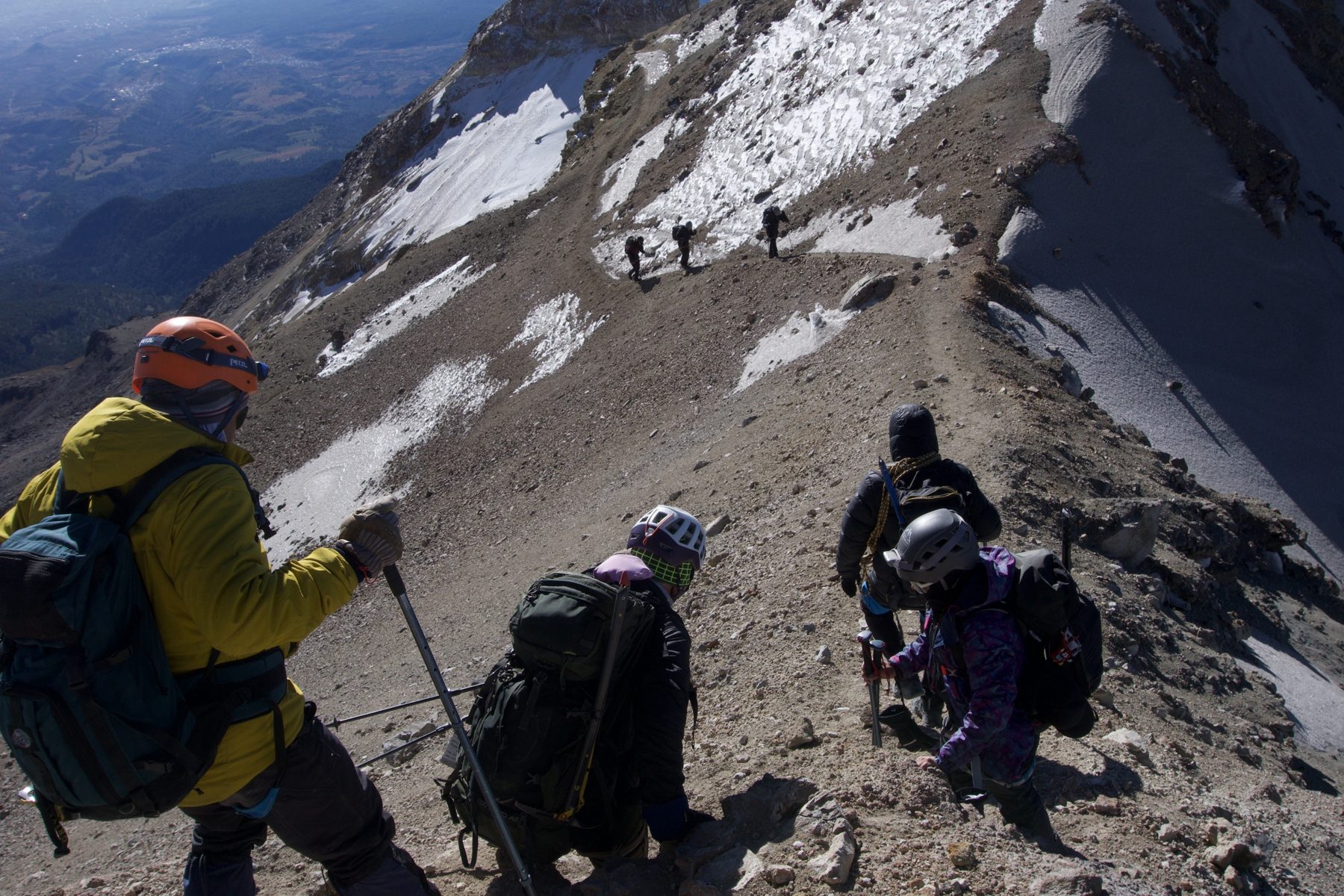
Mountain First Aid Basics for Climbing Mexico's Volcanoes
Most of what goes wrong on Mexico's volcanoes is small. A headache at the hut, cold hands before sunrise, a twisted ankle on the scree going down. Every now and then it isn't small, and the first few minutes depend on whoever is standing closest. This is what we'd want every climber to know before they leave Mexico City.
The short version. Make sure you're safe before you help. Check breathing and big bleeding first. On altitude, the answer to getting worse is going down, never alone. Cold that stops someone shivering is serious. When you hear thunder, get off the ridge. And when you call for help, say where you are before you say what happened.
This is general information for climbers. It isn't medical advice, and it doesn't replace a wilderness first aid course or a doctor. If you have a medical condition, talk to your doctor before your trip.
01 · Before anyone gets hurt
Decide now, not at 5,000 m
The most common way people fail to help isn't a lack of skill. It's waiting too long to admit something is wrong. Climbers who have already pictured themselves stepping in tend to act, so picture it now.
The other half happens at home. Tell your guide about your allergies, the medicines you take and any medical history before the climb, not at the trailhead. That's why we ask every climber to fill out a health and altitude questionnaire before the trip, and why your guide gets your answers before the climb. If you carry a prescribed medicine, like an epinephrine auto-injector or an inhaler, bring it and tell your guide where it lives in your pack.
02 · Stop and look
The first person you protect is you
Before you run to someone, take ten seconds. Is there falling rock, a steep slope below them, lightning nearby? How many people are hurt, and what happened? A rescuer who gets hurt turns one patient into two, and on a mountain that can mean nobody left to go for help. If the scene isn't safe, stay out of it and call for help.
03 · The order that saves lives
Breathing and bleeding come first
If someone collapses and doesn't respond, shout for help and check whether they're breathing normally. Gasping isn't normal breathing. If they aren't breathing normally, get someone calling for help and start chest compressions, hard and fast in the center of the chest, about 100 to 120 a minute. The American Heart Association says starting is better than waiting, even when you aren't sure.1 If they are breathing, roll them onto their side so the airway stays clear, and stay with them.
If there's heavy bleeding, press hard on the wound with a cloth or gauze and keep pressing. On an arm or leg, if bleeding that looks life threatening doesn't stop with pressure, a tourniquet goes 5 to 8 cm (2 to 3 in) above the wound, never on a joint, tightened until the bleeding stops, left in place, and the time written down. A purpose made tourniquet works far better than an improvised one. The Stop the Bleed course teaches this in about an hour.2
Everything else, the sprained ankle or the cut hand, waits until breathing and bleeding are handled.
04 · Altitude
The illness that climbs with you
Mexico City sits at 2,240 m. Iztaccíhuatl and Pico de Orizaba go much higher, and most of our climbers fly in from near sea level. Altitude illness comes in three forms.3
- Acute mountain sickness. A headache plus nausea, poor appetite, unusual tiredness or dizziness, often within the first day after going up. It looks a lot like a hangover or the flu.
- High altitude cerebral edema. Swelling of the brain. The warning signs are confusion, unusual behavior and stumbling. Someone who can't walk a straight line heel to toe needs to go down.
- High altitude pulmonary edema. Fluid in the lungs. Breathless even at rest, a cough, sometimes with frothy sputum, and much slower than the group.
The rule is simple. Mild symptoms mean you stop going up and rest. Symptoms that get worse, or any sign of the second or third kind, mean you go down, and someone always goes down with you. Even a few hundred meters lower makes a difference.3
Two things climbers often don't expect. The CDC says fitness and training don't change your risk of altitude illness,4 so a marathon doesn't protect you. And there are medicines that help prevent it, but that's a conversation for your own doctor before the trip, not something to start on the mountain. If you're coming from sea level, we suggest having that conversation with your doctor before you book flights. For the full picture, read how to deal with altitude sickness and how many days to spend in Mexico City first.
05 · Cold
Hypothermia hides in plain sight
You don't need a blizzard. Wind, damp clothes and standing still at a rest stop are enough. Early on, someone shivers hard, fumbles with zippers and starts mumbling. If they stop shivering while they're still cold, and get sleepy or confused, it's serious and they need more than a jacket.5
What helps is getting them out of the wind, putting insulation under them and not just on top, swapping wet layers for dry ones and covering the head. A warm, sweet drink helps if they're alert and can swallow. Handle a very cold person gently and keep them lying down.5
Frostbite shows up as numb, white or waxy skin on fingers, toes, nose or cheeks. Never rub it, and never rub it with snow. Thawing it is a job for a warm, sheltered place, because a part that thaws and freezes again on the way down ends up worse than one that stays frozen.6 Treat the whole person for cold before you worry about the fingers.
06 · Lightning
Get off the ridge early
On high ground, storms tend to build in the afternoon, which is one reason summit days start so early. NOAA's rule is to go indoors when you hear thunder and stay there until 30 minutes after the last clap.7 A tent isn't shelter either. On a mountain that means coming off summits and ridges, staying away from lone rocks and anything tall, and spreading the group out several meters apart so one strike can't hurt everyone. The storm isn't over when the rain stops.
If someone is struck, they don't carry a charge and you can touch them right away. Check breathing first. People hit by lightning often survive when they get help fast.
07 · Getting help
Say where you are first
In Mexico the emergency number is 911.8 When you get through, give your location first, with a landmark or GPS coordinates from your phone, then what happened, how many people need help and what you've already done. Don't hang up until they tell you to. If there's weak signal, a text to your guide or a friend sometimes gets through when a call won't, and a little higher ground can help. If someone has to walk out for help, two go together and they write down the details.
08 · How we climb
You shouldn't have to be the medic
On a guided climb with us, your guide is the one watching the group, turning around early and making the call to go down. Knowing the basics still matters. It helps you notice when a friend is off, tell your guide sooner, and be useful instead of frozen if something happens. If this got you curious, a wilderness first aid course, usually two days, is the best next step, and organizations like Wilderness Medical Associates International run them around the world.9
Planning a climb and worried about altitude or a health condition? Tell us the mountain, your dates and what's on your mind. We'll tell you how we'd plan it.
See our Iztaccíhuatl and Pico de Orizaba climbs.
Sources
- American Heart Association, When is the right time to perform CPR, and how should it be done?
- American College of Surgeons, Stop the Bleed.
- Luks AM and others, Wilderness Medical Society Clinical Practice Guidelines for the Prevention, Diagnosis, and Treatment of Acute Altitude Illness, 2024 Update, Wilderness & Environmental Medicine.
- CDC Yellow Book, High Altitude Travel and Altitude Illness.
- Dow J and others, Wilderness Medical Society Clinical Practice Guidelines for the Out of Hospital Evaluation and Treatment of Accidental Hypothermia, 2019 Update.
- McIntosh SE and others, Wilderness Medical Society Clinical Practice Guidelines for the Prevention and Treatment of Frostbite, 2024 Update.
- NOAA, Lightning safety.
- Uno TV, 911, 089 y 088, cuándo usar cada número en México.
- Wilderness Medical Associates International, wilderness first aid courses.

Prefer to Fill Out a Form?
We'll get back to you within 24 hours