Why You Feel Down on the Descent: Carbs, Protein and Mood on the Mountain
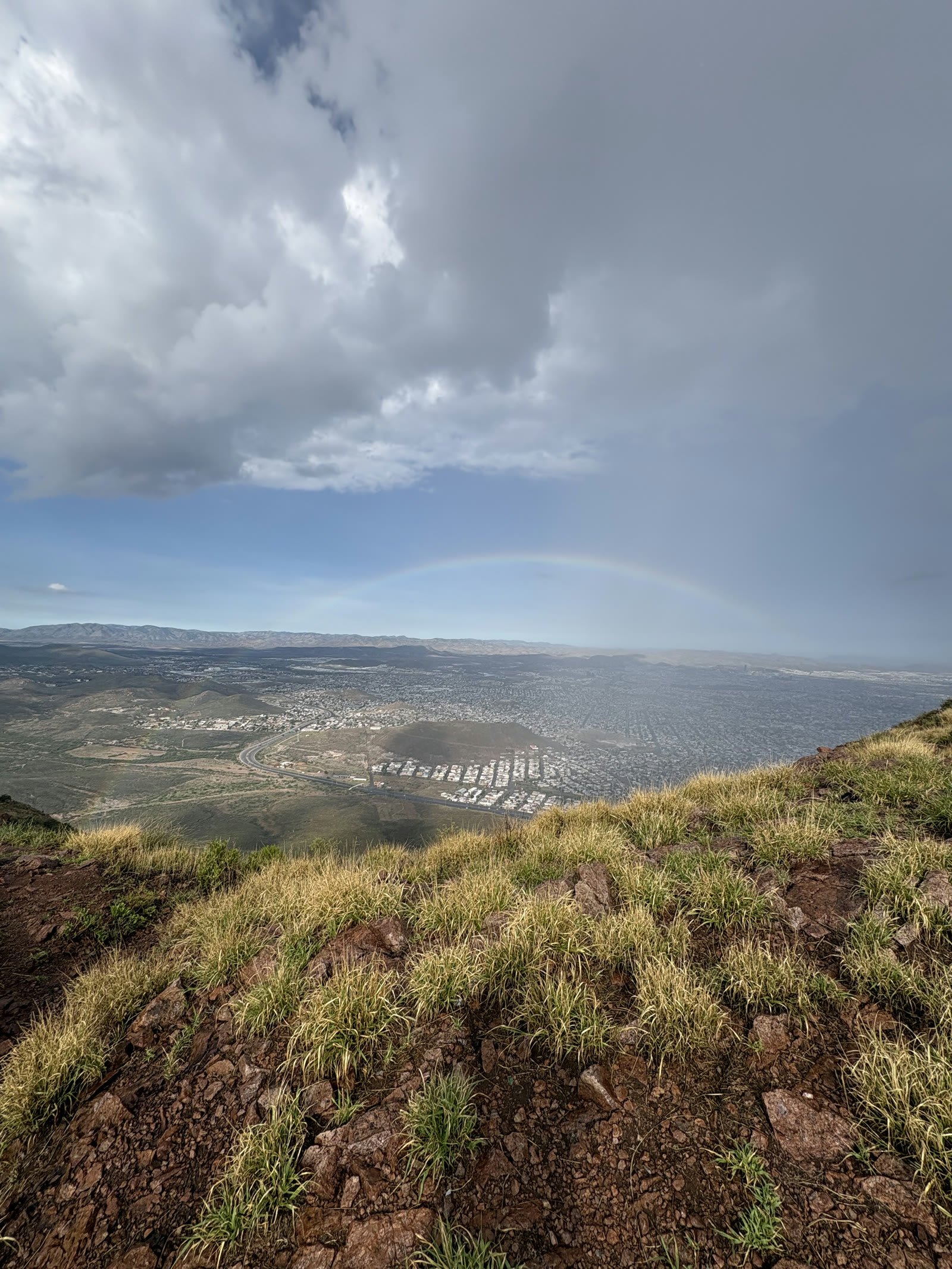
This Sunday I walked up Cerro Grande, a hill in Chihuahua I use for my long training days. It took 2 hours and 37 minutes for 441 meters of climbing. I held my heart rate low the whole way up, averaging 107, and the climb felt smooth. At the top I met two climbers from Poland and we talked for a long time.
On the way down something changed. My legs were fine. My mood wasn't. I felt flat and a little sad, the kind of low where your mind starts looking for a reason in your life. Work, money, whatever is nearby.
The reason wasn't my life. It was what I had eaten. Before leaving I had a shake with oats, peanut butter and coffee. On the hill, the only thing I ate was a can of tuna. That's a good amount of protein and zero carbohydrate. I had run out of the main fuel my brain runs on, and the first place it showed was my mood.
The short version. Carbohydrate is the fast fuel for your muscles and your brain, and you only store a few hours of it. Protein repairs muscle but does little for you while you're moving. Fat is a huge tank, but a slow one. When you've gone a few hours without carbohydrate, the first thing to go is often your mood, not your legs. On the mountain, eat something with carbohydrate every 30 minutes and save the protein for after. If you suddenly feel low, eat something sweet and give it 20 to 30 minutes before you decide anything.
01 · Three fuels
What carbs, protein and fat actually do
A calorie is a unit of energy. Carbohydrate and protein give you about 4 calories per gram, and fat about 9. But on a mountain the question isn't only how many calories you eat. It's which kind, and when.
| Fuel | What it does while you climb | When it matters |
|---|---|---|
| Carbohydrate | The fast fuel for your muscles and the main fuel for your brain. You store only a limited amount, so it runs down over a long day. | Before and during. Every 30 minutes once you're moving. |
| Fat | A very large reserve that your body burns well at an easy pace, but it releases energy slowly. | All day, in the background. It's why an easy pace feels sustainable. |
| Protein | Building material. It repairs and builds muscle. It makes only a small contribution as fuel. | After the effort, at meals. |
Your brain depends on glucose, the sugar carbohydrate turns into, as its main source of energy [1]. When blood sugar drops, your brain feels it before your quads do.
02 · Why the descent
Why the low hit on the way down
Going up, I was fine for three reasons. The oats in the shake were still working. At a heart rate of 107 my body was burning a lot of fat, which is exactly what an easy pace is for. And I was busy. The trouble showed up two and a half hours after my last carbohydrate, and the tuna couldn't cover it.
There's research on this. In a study where researchers lowered blood sugar in healthy people under controlled conditions, their mood dropped. They felt less pleasure, more tension and less energy, and a state the authors called "tense tiredness" lasted at least 30 minutes after their blood sugar was back to normal [2]. A three-week study that asked 64 people about their hunger five times a day found the same thing in everyday life. Hungrier moments came with more anger and irritability and less pleasure [3]. "Hangry" is real, and on a mountain it can feel like sadness.
That second detail matters. Your mood lags behind your blood sugar. Eat a date and you won't feel better at once. Give it 20 to 30 minutes.
03 · The numbers
How much carbohydrate, and how often
The standard guidance for endurance efforts is 30 to 60 grams of carbohydrate per hour for one to two and a half hours, and up to 90 grams per hour for longer efforts [4]. A summit day on Pico de Orizaba is well past that, often 9 to 13 hours round trip from the hut.
In food, 30 to 60 grams an hour looks like this, split into a bite every 30 minutes.
- Half a banana, about 12 to 15 g
- Four small dates, about 20 g
- Half an energy bar, about 15 to 20 g
- A honey packet, about 12 to 17 g
- A small handful of dried mango, about 20 g
Eating on the move is a skill, and your gut learns it. Eat carbohydrate during training often enough and you absorb more of it with less stomach trouble [5]. That's why my Sunday hikes now come with a watch alarm every 30 minutes. This Sunday I ignored it, and you just read how that went.
04 · Altitude
Up high, carbohydrate matters more
Two things change on Orizaba or Izta. First, in our experience most people's appetite drops up high, so they eat less just when they need more. Second, the body leans on blood sugar harder up high. In a classic study, men living at 4,300 meters for three weeks relied more on blood glucose as fuel during exercise than they did at sea level [6]. The hut on Orizaba sits at about 4,260 meters, so you start summit day already in that range.
Put those together and a high-protein, low-carbohydrate trail snack is the wrong tool for the job. Jerky and tuna are good food. They're just good food for dinner.
05 · Protein
Protein is for after
Protein matters a lot for anyone training for a big mountain, because it's what repairs the muscle the climb broke down. The best evidence points to meals with roughly 20 to 40 grams of protein spread through the day, including one soon after the effort [7]. My can of tuna would have been perfect at the car. On the hill it was the wrong food at the wrong time.
06 · On our climbs
How we handle it at Yacana
On our climbs the food is included, and on summit day the guide calls the eating stops on a schedule instead of waiting for anyone to feel hungry. The snacks are mostly carbohydrate, like dates, dried fruit and honey, because that's what works in the cold and the dark. The full timeline is in our summit fueling plan.
And we watch mood. If you go quiet on the descent, or start wondering why you're doing this, expect your guide to hand you something sweet before anything else.
The rule I'm keeping. If you feel a sudden low during or after a long effort, eat something sweet and wait 20 to 30 minutes before you draw any conclusions about your fitness, your climb or your life. If the mood comes back, it was fuel. Anything that is more than a low mood, like confusion, a bad headache or trouble walking straight at altitude, is not a snack problem. Tell your guide right away.
If you're training for Orizaba or Izta and want to know whether your long days are fueled well enough, send us your mountain, your dates and what you eat on your longest hike. You'll get a straight answer.
More reading: Zone 2 training for mountaineering · Summit fueling plan · How to train for Pico de Orizaba, Iztaccíhuatl and Ajusco. The trips: Pico de Orizaba · Iztaccíhuatl summit · La Malinche · Ajusco.
Written by Ricardo Guaderrama, professional mountain guide and founder of Yacana Outdoors. This is one guide's experience plus the research below, not medical advice. If you have diabetes or another condition that affects your blood sugar, plan your mountain fueling with your doctor.
Sources
- Mergenthaler P, Lindauer U, Dienel GA, Meisel A. Sugar for the brain: the role of glucose in physiological and pathological brain function. Trends in Neurosciences, 2013. PubMed
- Gold AE, MacLeod KM, Frier BM, Deary IJ. Changes in mood during acute hypoglycemia in healthy participants. Journal of Personality and Social Psychology, 1995. PubMed
- Swami V, Hochstöger S, Kargl E, Stieger S. Hangry in the field: an experience sampling study on the impact of hunger on anger, irritability, and affect. PLOS ONE, 2022. PubMed
- Thomas DT, Erdman KA, Burke LM. American College of Sports Medicine Joint Position Statement. Nutrition and Athletic Performance. Medicine & Science in Sports & Exercise, 2016. PubMed
- Jeukendrup AE. Training the Gut for Athletes. Sports Medicine, 2017. PubMed
- Brooks GA, Butterfield GE, Wolfe RR, et al. Increased dependence on blood glucose after acclimatization to 4,300 m. Journal of Applied Physiology, 1991. PubMed
- Jäger R, Kerksick CM, Campbell BI, et al. International Society of Sports Nutrition Position Stand. Protein and exercise. Journal of the International Society of Sports Nutrition, 2017. PubMed


